QUICK OVERVIEW
What to take away from the article
- Choose the technology together with the specific clothing and motif.
- The price depends on both preparation and repeated production; there is no universal quantitative break.
- The sample and agreed care are more important than the general promise of lifetime.
Five inputs that decide for you
Prepare the logo in a suitable format, the required size and location, the textile model, the size breakdown and the number of pieces. Add information whether it is a one-time event, work wear or a gift for a client. Otherwise, the price is compared without the offers being comparable.
When it comes to work clothes, also consider comfort and conditions of use. A large continuous printed area on the back may look different than a small logo on the chest. The motif will behave differently on a thin elastic material than on a solid sweatshirt. If regular reordering is expected, ask about availability of the same model and which preparatory work is repeated for the next batch.
Where to look for suitable technology
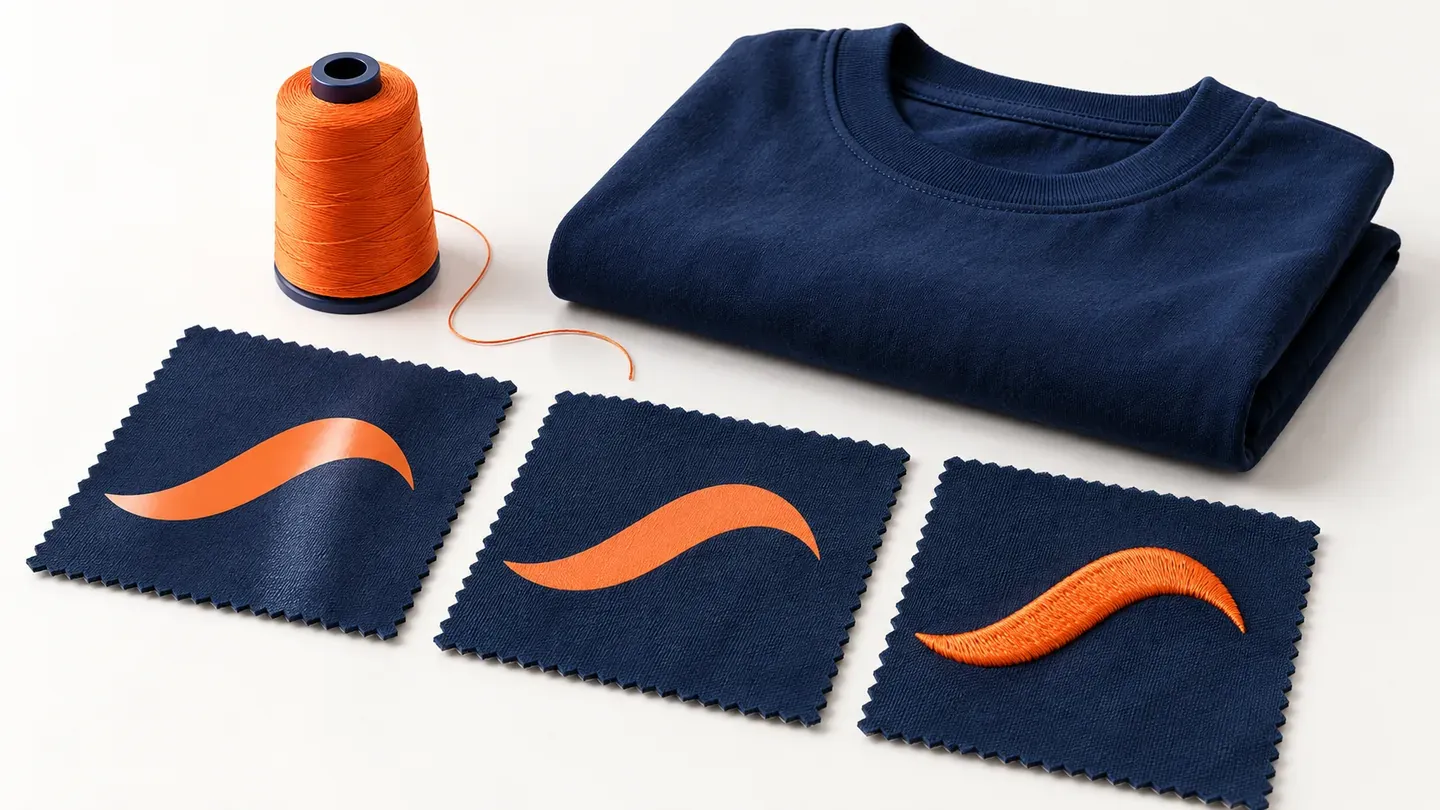
DTF transfers the prepared motif from the foil to the fabric using a suitable glue and heat. Screen printing applies color through a prepared screen. Embroidery creates a motif with a thread and requires its processing into an embroidery program. These are different processes; a quality result also depends on the setting and production experience.
Use the table as a starting point for consultation. It does not determine that one method is always the cheapest or most durable. For a specific material, compatibility can decide, while for a fine logo, whether it remains legible in the required size.
| Area | Postup | What to check |
|---|---|---|
| DTF | Colorful motif, smaller series or different graphic variants. | Feeling to the touch, edges, elasticity and reaction of textiles to heat. |
| Screen printing | The same motif is repeated, especially if preparation is budgeted. | Coverage, press accuracy and suitability of the color for the garment. |
| Embroidery | A logo where you want a three-dimensional thread look. | Readability of details, background and waviness of the material. |
Why can't a single limit be set for the number of pieces?
The total price consists of the textile, preparation, motif application, packaging and possible tests. Technology with higher one-time preparation can improve the price per piece for more pieces. However, the result changes the number of colors, locations, size of the graphic and the number of different designs. A hundred pieces with the same logo is not the same as a hundred individual names.
Request a comparison for specific quantities and the same garment. Please specify the preparation and the price of the reorder separately. Don't automatically add a one-time cost to every future series, but don't expect to reuse it for free either. You can get a better grasp of scope and approval via quote structure.
Polyester and small details need testing
In the case of polyester clothing, the dye can migrate from the fabric to the print after heat treatment. Roland DG draws attention to this phenomenon in DTF applications. Therefore, the quality cannot be decided only by the immediate look after pressing. Production should choose a compatible procedure and verify the result on the given material.
For embroidery, ask for a simplified design if the logo contains very thin lines or small text. The printable file does not need to be a finished embroidery program. For each technology, check readability at actual size, not on a magnified monitor. Instead of a universal temperature or number of washes, ask for instructions for a specific combination of clothing and application.
What exactly to approve before the whole series
The approval should include the model and color of the garment, the location, the size of the motif, its appearance and a list of sizes. A photo of the swatch can help, but it won't judge feel, flexibility, or true color impression. Therefore, a physical sample makes sense for a sensitive order.
Agree in advance what will happen if clothing or graphics are changed after approval. Even an apparently identical replacement textile may require a new test. Keep the final document with the order so that the older logo is not used when re-ordering. Practical principles of document control can also be found in the instructions for PDF preparation for printing; however, the technological requirements for the textile must be confirmed separately.
An assignment from which you will receive a usable price
In the inquiry, write the purpose, the number of pieces, the date, the desired garment and attach the logo. If you are not familiar with the technology, describe the expected result: fine detail, unobtrusive marking, bold color graphics or spatial appearance. The supplier can then propose meaningful alternatives and explain the difference in price.
Compare the entire delivery including testing, preparation, packaging and reorders. A cheaper piece that the employee does not wear or has to replace may not be a savings. Therefore, connect the decision with real use and not only with the image in the price offer.